Lombard Protocol - Full-Stack Bitcoin Infrastructure

Onchain Bitcoin Capital Markets Infrastructure

Lombard Protocol delivers comprehensive infrastructure for onchain Bitcoin Capital Markets, enabling Bitcoin integration across 12 blockchains through liquid staking, yield products, cross-chain bridges, and developer tools.

Explore Protocol

LBTC Protocol - Liquid Staking Infrastructure

The LBTC Protocol represents a sophisticated liquid staking mechanism that transforms how Bitcoin interacts with decentralized finance. By staking Bitcoin through Lombard, participants receive LBTC tokens that represent their staked position and automatically accrue yield.

Protocol Architecture:

  • Liquid Staking Model: Maintain liquidity while earning Bitcoin yield
  • Automatic Yield Accrual: LBTC value increases continuously as rewards accrue
  • Multi-Chain Integration: LBTC operates across 12 leading blockchains
  • DeFi Composability: LBTC integrates with existing DeFi protocols
  • Proven Scalability: Achieved $1B TVL in 92 days
  • High Utilization: 82% of LBTC actively deployed in DeFi

The liquid staking model eliminates the traditional trade-off between Bitcoin yield and asset liquidity. Users can earn staking rewards while simultaneously deploying their LBTC tokens in other DeFi protocols, maximizing capital efficiency and yield potential across the ecosystem.

Technical Implementation:

The LBTC Protocol manages Bitcoin staking operations and reward distribution through a secure, decentralized infrastructure. LBTC tokens maintain a dynamic ratio with staked Bitcoin plus accrued rewards, enabling seamless integration with DeFi protocols while preserving the underlying Bitcoin value.
LBTC Protocol Architecture

Lombard Vaults Infrastructure

Lombard Vaults Infrastructure

Lombard Vaults provide institutional-grade infrastructure for curated yield strategies. These vaults are actively managed by leading risk managers and offer sophisticated yield products designed specifically for Bitcoin and Bitcoin-backed assets.

Infrastructure Features:

  • Risk Management: Professional risk managers oversee all vault operations
  • Strategy Curation: Carefully selected yield opportunities across protocols
  • Institutional Standards: Built to meet institutional requirements
  • Transparency: Real-time performance tracking and reporting
  • Scalability: $750M TVL demonstrates infrastructure capacity
  • Diversification: Multiple vault strategies for risk management

The vault infrastructure employs sophisticated risk management frameworks and algorithmic strategies to optimize yield while maintaining appropriate risk levels. This creates a comprehensive ecosystem for Bitcoin yield generation that serves both retail and institutional participants.

Technical Architecture:

Lombard Vaults operate on a modular infrastructure that enables flexible strategy deployment, real-time risk monitoring, and automated rebalancing. The infrastructure integrates with multiple DeFi protocols to provide diversified yield opportunities while maintaining security and transparency.

Cross-Chain DeFi Marketplace Infrastructure

The Lombard DeFi Marketplace provides comprehensive infrastructure for Bitcoin DeFi operations across 12 leading blockchains. This unified platform aggregates lending, borrowing, and trading opportunities while maintaining security and efficiency.

Infrastructure Components:

  • Multi-Chain Architecture: Unified interface across 12 blockchains
  • Protocol Aggregation: Access to multiple DeFi protocols from single platform
  • Liquidity Infrastructure: $3B net-new liquidity onboarded
  • Cross-Chain Routing: Efficient asset routing across chains
  • Unified Interface: Single dashboard for all DeFi operations
  • Yield Optimization: Automated yield discovery and optimization

The marketplace infrastructure employs advanced routing algorithms and protocol integrations to provide users with optimal DeFi opportunities across all supported chains. This creates a comprehensive ecosystem where Bitcoin can be fully utilized across the decentralized finance landscape.

Technical Implementation:

The infrastructure utilizes cross-chain messaging protocols, liquidity aggregation mechanisms, and unified smart contract interfaces to enable seamless Bitcoin DeFi operations. This technical foundation ensures security, efficiency, and user experience across all supported blockchains.

Cross-Chain DeFi Marketplace Infrastructure

Bitcoin Staking Infrastructure on Babylon

Bitcoin Staking Infrastructure

Lombard operates Bitcoin staking infrastructure through 4 Finality Providers on the Babylon protocol, in partnership with Galaxy, Kiln, P2P, and Figment. This infrastructure enables native Bitcoin staking while maintaining security and decentralization.

Infrastructure Architecture:

  • Finality Providers: 4 independent Finality Providers ensure redundancy
  • Partnership Model: Operated with Galaxy, Kiln, P2P, and Figment
  • Babylon Integration: Built on Babylon's Bitcoin staking protocol
  • Decentralized Operations: Multiple operators ensure network health
  • Native Bitcoin: Direct staking of real Bitcoin, not wrapped tokens
  • Security First: Institutional-grade security and monitoring

This infrastructure provides a secure and decentralized foundation for Bitcoin staking on Babylon. By operating with multiple trusted partners, Lombard ensures redundancy and security while enabling Bitcoin holders to earn staking rewards through native Bitcoin staking.

Technical Specifications:

The staking infrastructure utilizes Babylon's Proof-of-Stake consensus mechanism, enabling native Bitcoin to be staked without wrapping or custodial solutions. The multi-provider architecture ensures high availability and security through redundancy and independent operation.

Lombard Ledger - Bridge Infrastructure

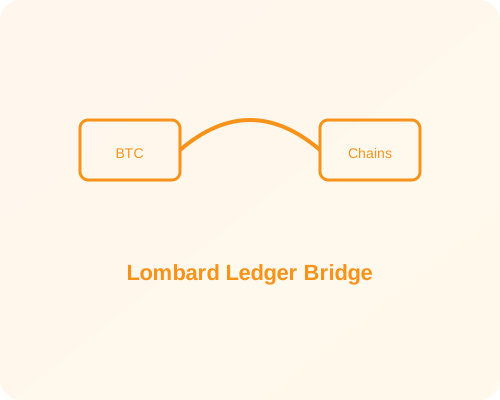
Lombard Ledger represents institutional-grade bridge infrastructure secured by 14 trusted digital asset institutions. This bridge enables secure cross-chain Bitcoin transfers while maintaining the highest security standards through multi-signature and institutional oversight.

Bridge Architecture:

  • Institutional Security: Secured by 14 trusted digital asset institutions
  • Multi-Signature: Multi-signature security model for all operations
  • Cross-Chain Protocol: Efficient Bitcoin bridging across multiple chains
  • Trusted Operators: Leading institutions ensure bridge security
  • High Availability: Redundant infrastructure for reliability
  • Transparent Operations: On-chain verification of all bridge operations

The bridge infrastructure represents the gold standard for Bitcoin bridges, combining institutional security with efficient cross-chain functionality. The involvement of 14 trusted institutions ensures that the bridge operates with the highest security standards and maintains transparency.

Security Model:

Lombard Ledger employs a multi-signature security model where operations require approval from multiple trusted institutions. This creates a robust security framework that prevents single points of failure while enabling efficient cross-chain Bitcoin transfers.

Lombard Ledger Bridge Infrastructure

Lombard SDK - Developer Infrastructure

Lombard SDK Infrastructure

The Lombard SDK provides comprehensive developer infrastructure for integrating Bitcoin functionality into applications. This toolkit enables developers to embed native BTC deposits, yield products, and cross-chain functionality directly into any chain, protocol, or wallet.

SDK Infrastructure:

  • API Integration: RESTful APIs for Bitcoin deposit and yield operations
  • Smart Contract Libraries: Pre-built smart contracts for common use cases
  • Multi-Chain Support: SDK works across all supported blockchains
  • Wallet Integration: Seamless integration with popular wallet providers
  • Documentation: Comprehensive developer documentation and examples
  • Developer Tools: Testing frameworks and development utilities

The SDK infrastructure democratizes access to Bitcoin functionality, enabling any developer to integrate Bitcoin support into their applications. This opens up new possibilities for Bitcoin adoption across the entire crypto ecosystem, unlocking the $6T value potential when developers innovate with BTC.

Integration Capabilities:

The SDK provides modular components that can be integrated into existing applications with minimal code changes. This includes wallet connectors, deposit handlers, yield product interfaces, and cross-chain routing utilities, all designed for easy integration and maximum flexibility.

BARD Token - Governance Infrastructure

The BARD token serves as the governance mechanism for the Lombard Protocol, enabling token holders to participate in protocol governance, security operations, and ecosystem development. BARD holders can vote on proposals, participate in staking for security, and access protocol utilities.

Governance Features:

  • Protocol Governance: Vote on fee policies, product roadmaps, and ecosystem grants
  • Security Participation: Stake BARD to secure LBTC bridge and Lombard Ledger
  • Protocol Utility: Discounts and priority access to new Lombard products
  • Liquid Bitcoin Foundation: Governance over ecosystem grants and development
  • Transparent Voting: On-chain voting with full transparency
  • Staking Rewards: Earn rewards for securing protocol infrastructure

The BARD governance infrastructure creates a decentralized decision-making framework for the Lombard Protocol. Token holders can influence protocol development, security parameters, and ecosystem growth through transparent on-chain voting mechanisms.

Governance Model:

BARD token holders participate in governance through proposal submission, voting, and execution. The governance infrastructure supports various proposal types including protocol upgrades, fee adjustments, product launches, and ecosystem grants from the Liquid Bitcoin Foundation.

BARD Governance Infrastructure

Security Infrastructure & Consortium

Lombard Protocol maintains institutional-grade security through a consortium of leading digital asset institutions. This collaborative security model ensures continuous monitoring, auditing, and protection of all protocol infrastructure.

Security Infrastructure Components:

  • 14 Trusted Institutions - Securing Lombard Ledger bridge operations
  • Multi-Signature Security - All critical operations require multiple approvals
  • Chainlink Integration - Industry standard for Bitcoin price feeds in DeFi
  • Galaxy Infrastructure - Bitcoin staking infrastructure partner
  • Kiln Operations - Finality Provider infrastructure
  • P2P Infrastructure - Staking infrastructure partner
  • Figment Operations - Finality Provider infrastructure

This security infrastructure ensures that Lombard Protocol operates with the highest security standards. The consortium model creates redundancy and distributed trust, while continuous monitoring and auditing maintain protocol integrity across all infrastructure components.

Protocol Performance Metrics

$1B

Fastest yield-bearing token to reach $1B TVL (92 days)

$3B

Net-new liquidity onboarded to 12 blockchains

$750M

TVL across Lombard's vault infrastructure

270K

LBTC protocol users across the globe

82%

LBTC actively deployed in DeFi protocols

$6T

Value potential unlocked for Bitcoin innovation

Protocol Vision & Architecture

Lombard Protocol is building full-stack infrastructure for onchain Bitcoin Capital Markets. The protocol enables Bitcoin to fully participate in the onchain revolution it inspired, unlocking the potential of $2 trillion in idle Bitcoin.

Protocol Architecture Principles:

  • Full-Stack Infrastructure: Complete infrastructure for Bitcoin capital markets
  • Multi-Chain Architecture: Bitcoin integration across 12 leading blockchains
  • Institutional Grade: Built to meet institutional security and compliance requirements
  • Developer Focus: Comprehensive SDK and tools for ecosystem development
  • Decentralized Governance: BARD token enables community-driven protocol evolution

Founded in 2024, Lombard Protocol pioneered Bitcoin's integration into DeFi with LBTC, the leading liquid staked token secured by a consortium of top institutions. Today, Lombard continues to build comprehensive infrastructure to accelerate onchain BTC adoption by holders, protocols, and platforms.